In environments with high product turnover, a multi-format line allows switching between different product sizes and box types with automatic and instantaneous changeovers in cardboard boxes. Automatic changeover improves line availability and reduces downtime.
It can handle:
- Different package sizes
- Master packs
- Trays and displays
- Shrink-wrapped groupings
- Different palletizing patterns
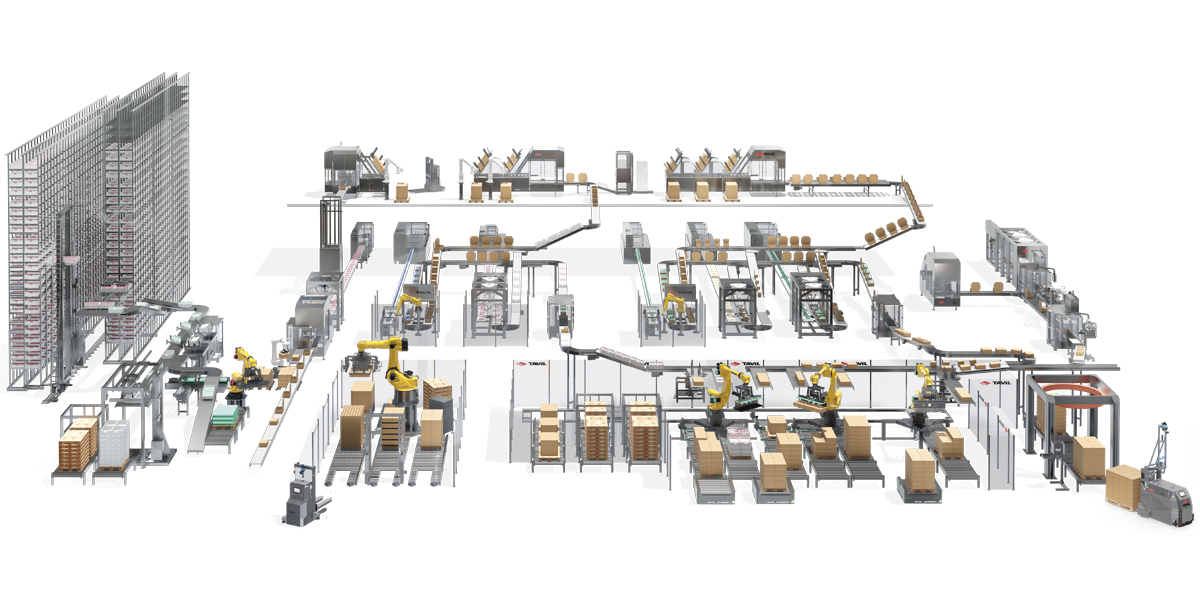
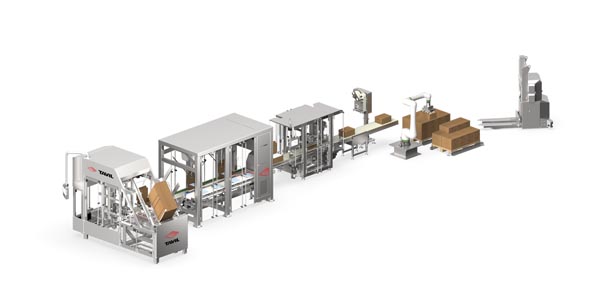
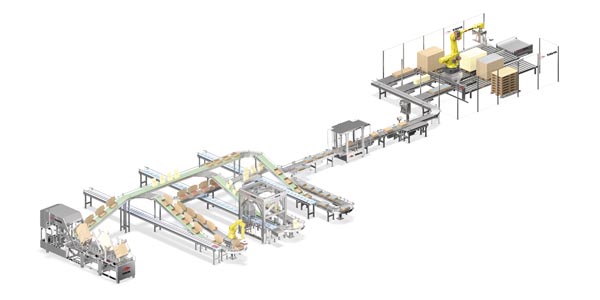
A complete multi-format end-of-line project integrates case packing, case closing, palletizing, and logistics systems into a single, coordinated solution. This approach allows for the management of multiple formats with automatic changeover, optimizing productivity and reducing downtime.
It can include:
- Multi-format case forming
- Automatic case packing
- Case closing and capping
- Palletizing with automatic tile editing
- Transport and internal logistics
- Data management and OEE control
Automatic format change allows the machine to adapt to different box sizes through digital selection, without manual mechanical adjustments. This system reduces downtime and improves line availability in multi-format environments.
This may involve:
- Automatic guide adjustment
- Digital recipe modification
- Automatic pattern adaptation
- Synchronization with production systems
A modular system allows for expanding or adapting the installation without completely replacing the existing equipment. This architecture facilitates scalability and optimizes investment.
The modular design allows for:
- Adding new feeders
- Working multiple lines simultaneously
- Adapting to the available space
- Integrating new enclosure types
- Progressively improving production capacity
End-line automation in the meat industry is applied at the end of the production chain through automatic box forming, product loading, sealing, palletizing, wrapping, and labeling.
It offers various packaging options to differentiate the product at its final destination, incorporates box formers that produce perfectly shaped boxes and guarantee product integrity, increases the efficiency of packaging areas, and employs automated systems that boost production without adding manual labor.
It reduces labor costs, as automatic packaging lines can operate 24/7, and improves the efficiency of the packaging area by increasing packaging and palletizing speed, increasing the productive capacity of factories, standardizing box sizes and product packaging, and allowing companies to reduce the final price of products by lowering their costs.
A multi-format packaging line can change formats in seconds, switching from a standard shipping carton to a display-ready box.
This reduces uncertainty regarding potential new formats or future requests, allows for easy SKU changes without manual adjustments, and enables any operator to start up the line and change formats without requiring engineering knowledge.
There are different solutions depending on the type of product and the speeds; for example, if the product is heavy, an anthropomorphic robot is usually more suitable, while for lighter products a delta robot may be more convenient.
A Maxpallet palletizer has a multi-format head capable of changing the size of the head itself and adjusting the movements according to the palletizing pattern, recognizing the shape with sensors and machine vision, incorporating a multi-format head and more than one pallet position and using software that allows the system to identify and change between sizes automatically.
Automating a meat packaging line makes sense when production volume is significant and labor costs for packaging and palletizing are high compared to the overall operation.
- When the company seeks to reduce labor costs.
- When it wants to improve its financial results through investments that reduce future operating costs.
- When the end user requests boxes with a better visual finish and different designs, or when standardized packaging is a requirement of the end customer.
Multi-format end-of-line automation in poultry allows for the management of different box and tray formats within the same cell, maintaining consistent throughput and load stability. This is especially useful when there are:
- Frequent changes in product type and weight
- A combination of fresh, frozen, and IQF products
- Space and labor limitations in cold storage
- Traceability requirements by batch and customer
- Integration with shipping and automated warehouses
In poultry environments with high SKU turnover, multi-format technology supports different weights, tray sizes, and packaging types (fresh, frozen, IQF) without lengthy mechanical adjustments. Recipe changes are executed from the HMI, and the line is synchronized with cutting, deboning, and packaging.
Multi-format packaging lines for poultry allow you to work with various tray and box sizes without mechanical adjustments. They are ideal when the following is required:
-Operating with different types of boxes
-Changing formats per recipe via the HMI
A multi-format solution is advantageous when flexibility is needed without increasing the number of lines or cells. It is often the best option in plants with:
- A broad portfolio of poultry products
- Medium or variable volumes per SKU
- Sales to multiple channels (retail, food service, industry)
- The need to change formats several times a day
- The objective of limiting CAPEX and space requirements
Multi-format end-of-line systems for poultry must handle different types of boxes and trays in a cold and hygienic environment. They are typically required to:
- Automatically adjust formats
- Operate in refrigerated or frozen areas
- Withstand frequent cleaning and chemical agents
- Operate at high throughput with controlled accumulation
- Integrate with weighing, labeling, and barcode reading
Automation increases efficiency in pet food packaging by reducing manual handling, stabilizing production speeds, and improving line consistency.
- Consistent production speeds with minimal variability.
- Reduced reliance on manual labor for repetitive end-of-line tasks.
- Improved product flow between bagging, boxing, and palletizing.
- Reduced risk of human error and production interruptions.
End-of-line automation in pet food typically includes case forming, robotic packaging, case sealing, and robotic palletizing systems.
- Automated case forming and sealing equipment.
- Robotic pick-and-place systems for bags or pouches.
- High-speed robotic palletizing solutions.
- Integrated conveyor and product handling systems.
Automated pet food packaging systems typically handle between 10 and 40 cases per minute, depending on the product format, bag size, and line configuration.
- Speed depends on bag weight, size, and product type.
- Robotic systems allow for scalable throughput based on production needs.
- Multi-lane configurations can increase packaging capacity.
- Integrated buffer systems help maintain consistent line speeds.
Robotic palletizing improves production efficiency by increasing palletizing speed, ensuring consistent pallet quality, and reducing manual labor.
- High palletizing accuracy and repeatability.
- Ability to handle multiple bag sizes and box formats.
- Improved workplace ergonomics and worker safety.
- Consistent pallet stability for transport and storage.
Yes, modern automated systems are designed to handle multiple bag sizes and packaging formats through programmable format changes.
- Automatic or rapid format changes between SKUs.
- Flexible gripping systems for different bag types.
- Software-based recipe management for product formats.
- Reduced downtime when changing production batches.
The return on investment for automation in pet food manufacturing typically ranges from 1.5 to 3 years, depending on production volume and labor costs.
- Reduced labor costs in end-of-line operations.
- Increased production output and line efficiency.
- Less product damage and packaging errors.
- Improved operational reliability and uptime.
Yes. An automatic case packing system can handle gummy candy bags of irregular volume as long as it's designed with adaptive handling and control systems that compensate for variations in shape and fill level.
- 3D vision systems for position and volume detection
- Flexible and adaptive grippers or gripping heads
- Automatic grouping and case packing pattern adjustments
- Servo-driven control for precise movements
On multi-format lines with automatic adjustments, new formats can be introduced without mechanical modifications, provided they are within the specified dimensional range.
- Recipes configurable via HMI
- Automatic adjustments using servo-driven axes
- Format change without part replacement
- Adaptation within defined width, length, and height ranges
Yes. An automatic packaging system can position chocolate tablets vertically for display.
- Product guidance and grouping systems
- Product loading robot for vertical positioning on the display
- Precise control via servo-driven axes
- Automatic adjustment according to box dimensions and type
Yes. An automatic case packing system can combine two different SKUs in the same box.
- Programming of mixed patterns from the HMI
- Counting and sequencing control by SKU
- Vision or barcode reading systems for verification
- Automatic synchronization of both feeds with the automatic loading inside the box
In mixed configurations, the system integrates synchronized dual input and logic control that ensures the correct ratio (e.g., 50/50 or alternating patterns). It can include machine vision or scanner verification to guarantee traceability and prevent combination errors before the box is sealed.
Automation improves efficiency on sauce and dressing packaging lines by stabilizing production speed, reducing manual handling, and optimizing end-of-line operations.
- Consistent throughput on high-volume bottling or pouch packaging lines.
- Reduced manual handling during packaging and palletizing.
- Improved line synchronization between filling and packaging.
- Increased operational reliability and production uptime.
Typical end-of-line automation includes case forming, robotic packaging, sealing, and palletizing systems.
- Automated case forming and sealing equipment
- Robotic pick-and-place systems for bottles, jars, or bags
- High-speed palletizing solutions for finished cases
- Integrated product handling and conveying systems
Yes, modern automation systems can handle bottles, jars, or bags of various sizes thanks to flexible handling systems and programmable changeovers.
- Adjustable product handling systems for different container sizes
- Programmable recipes for different product codes and container formats
- Ability to quickly change between production cycles
- Flexible gripping systems for multiple container types
Robotic palletizing improves pallet stability, production efficiency, and operational safety in the manufacture of sauces and dressings.
- High palletizing accuracy and uniform pallet patterns.
- Ability to handle different box sizes and pallet configurations.
- Reduced manual labor in heavy palletizing tasks.
- Improved workplace safety and ergonomics.
Automated systems help manage high production volumes while maintaining consistent speeds and minimizing downtime in packaging operations.
- High-speed packaging and palletizing capabilities
- Continuous product flow from filling to palletizing
- Buffering systems to absorb production variations
- Reduction of line stoppages caused by manual handling
The return on investment (ROI) of automation in the production of sauces and dressings depends on production volume, packaging formats, labor costs, and improvements in operational efficiency.
- Reduced labor in end-of-line operations
- Increased throughput and efficiency of the packaging line
- Lower risk of product damage or packaging errors
- Increased operational uptime and production reliability
Automation improves efficiency in the packaging of frozen and prepared meals by stabilizing production speed, reducing manual handling, and optimizing end-of-line operations.
- Consistent throughput in the production of trays and boxes with a wide variety of products.
- Reduced manual handling in cold or frozen environments.
- Improved synchronization between filling, sealing, and packaging.
- Increased operational reliability and line uptime.
Typical end-of-line automation includes case forming, robotic tray or carton loading, case sealing, and palletizing systems.
- Automated case forming and sealing equipment
- Robotic pick-and-place systems for trays and cartons
- Flexible palletizing solutions for multiple case formats
- Integrated conveyor systems designed for cold environments
Yes, automated systems are designed to handle multiple tray sizes, box formats, and SKU variations with programmable changeovers.
- Multi-format handling for trays, sleeves, and boxes
- Programmable recipes for different SKUs
- Quick changeover capability between production batches
- Flexible gripping systems adapted to various packaging formats
Robotic palletizing improves pallet uniformity, production speed, and worker safety in frozen food manufacturing.
- High palletizing accuracy and repeatability.
- Ability to handle boxes of varying weights and dimensions.
- Reduced worker exposure to cold storage conditions.
- Greater pallet stability for frozen food distribution chains.
Modern automation systems are designed to operate reliably in cold and frozen environments, thanks to the appropriate selection of materials and components.
- Use of components suitable for low temperatures.
- Corrosion-resistant materials and protective housings.
- Reliable motion control in temperature-controlled areas.
- Optimized integration with freezing and cold storage workflows.
The return on investment (ROI) for automating frozen and prepared meals depends on production volume, product variety, labor costs, and improvements in operational efficiency.
- Reduction of labor-intensive packaging tasks
- Increased production throughput and line stability
- Faster format changeovers in high-product-variety production environments
- Increased operational uptime and reduced downtime
Yes. Thanks to multi-format packaging, flexible gripping systems, and programmable palletizing patterns, bakery products can be switched between SKUs with minimal downtime, maintaining efficiency, traceability, and product integrity thanks to automatic changeover technology.
In bakery environments with a high product variety (sliced bread, rolls, pastries, vacuum-packed products, boxes, trays), end-of-line solutions can include:
- Multi-format packaging machines with automatic changeover.
- Robotic loading systems with adaptable grippers.
- Vision systems for product orientation and verification.
- Palletizing robots with dynamic layer pattern software.
- Recipe-based changeovers managed via HMI.
- Integration with MES/ERP for production synchronization.
An end-of-line system can handle different box sizes and types using multi-format technology, automatic adjustments, and recipe-based format changes. Thanks to adjustable guides, flexible gripping systems, and programmable packaging and palletizing patterns, the line adapts quickly to new formats with minimal downtime, maintaining efficiency and stability.
To manage format variability (packmasters, trays, display-ready packaging, etc.), end-of-line solutions include:
- Automatic length, width, and height adjustments using servomotors.
- Recipe management via HMI for quick format selection.
- Robotic packers with adaptable tooling.
- Automatic case erectors and sealers with multi-format capability.
- Vision systems for box identification and positioning.
- Palletizing software with an automatic editing system for new patterns.
- Integration with legacy equipment and MES/ERP for synchronized format changes.
Yes. An automated end-of-line system can pack two different SKUs in the same box using a controlled product sequence and intelligent box loading. With the right configuration, the system ensures accurate product counting, positioning, and traceability, maintaining production speed without manual intervention.
Packing boxes with mixed SKUs is typically achieved through:
- Product tracking systems.
- Controlled infeed lanes that combine different SKUs in a defined sequence.
- Robotic packers with programmable loading patterns.
- Recipe-based configuration via HMI for predefined pattern combinations.
- Check scales or visual inspection to verify the correct assortment.
- Integration with MES/ERP for on-demand mixed-box production.
This approach allows for the creation of promotional packs, varied assortments, and configurations specific to each retailer, while maintaining line accuracy and efficiency.
The best solution for frequent format changes is a fully automated, servo-driven end-of-line system with recipe-based format changeover and robotic handling. This type of system minimizes manual adjustments, reduces downtime, and ensures consistent performance across multiple SKUs, case sizes, and pallet configurations.
End-of-line automation in the production of cookies with flexible packaging involves integrating packaging, sealing, and palletizing into a synchronized, multi-format system.
Through robotic handling and recipe-based format changes, the line adapts to different package sizes and box formats, maintaining product integrity, speed, and traceability.
In the production of cookies with flow-wrap flexible packaging, an automated end-of-line solution typically includes:
- Intermediate storage and product orientation systems after flow-wrap.
- Multi-format box forming machine.
- Robotic or delta pick-and-place units for the gentle handling of flexible packaging.
- Multi-format box closing machine.
- Quality control using checkweighers.
- Robotic palletizers with automatic generation of dynamic patterns.
- Centralized control with recipe management via HMI. - Integration with MES/ERP for production tracking and order-based configuration.
This architecture reduces manual handling, prevents packaging deformation, increases line efficiency, and allows for quick format changes between different cookie types and promotional assortments.
There are end-of-line systems designed as a flexible, multi-format solution that allows for the incorporation of new formats without additional investment or structural modifications, thanks to servo-driven technology.
- Multi-format technology allows for the addition of new box sizes and formats at no extra cost, simply by adding them via the touchscreen.
- Robotic packaging machines with flexible end-of-arm tools can handle new dimensions within an existing range.
- Automatic adjustments via servomotors eliminate the need for mechanical change parts.
Snack products can be packaged in different types of boxes, depending on the distribution channel and the presentation at the point of sale. Multi-format lines allow working with different box designs on the same plant.
The most common formats are:
- CSR cardboard boxes
- Wrap-around boxes
- Ready-to-sell packaging
- Cardboard trays with film
- Boxes with base and lid
- Shipping boxes
What types of snacks can be automatically stacked?
Automated packaging systems can process a wide variety of snacks, adapting the clamping and grouping system to the geometry and stability of the product. This allows processing different types of products on the same production line.
Among the products that are usually processed are:
- Pillow bags or flowpacks
- Stand-up pouches or bags with a base
- Thermoformed trays
- Shrink-wrapped multipacks
Multi-format solutions allow you to work with different product sizes and box types through automatic format changeover. This reduces downtime and improves line availability in plants with multiple SKUs.
The system adapts to:
- Different bag sizes
- Changes in product orientation
- Variations in the number of units per box
- Different box models
- Different packaging patterns
The speed of the packaging system depends on the product characteristics and the design of the handling system. The solution is sized to meet the required speed without compromising stability or accuracy.
The main factors include:
- Line units per minute
- Number of products per cycle
- Product type (flexible or rigid)
- Grouping system
- Complexity of the loading pattern
Automated palletizing allows you to organize finished product boxes into stable patterns that facilitate transport and storage. The system adapts to different box types and load configurations.
End-of-line automation in the produce and dry goods sector enables the continuous management of tray forming, product packaging, and final palletizing. These solutions are designed to adapt to different packaging formats and varying production rates within the same plant.
The system can integrate:
- Multi-format tray formers
- Automatic product packaging
- Container or package grouping
- Box or sack palletizing
- Automatic product transport
- Production control and traceability
Dry goods such as cereals, rice, or flour can be packaged in various formats depending on the distribution method and the product's weight. Automated lines adapt to these formats using multi-format systems.
The most common formats include:
- Flexible bags or packaging
- Paper or plastic sacks
- Retail boxes
- Bundled packs
- Shipping boxes
- Big bags or industrial sacks
Automated packaging systems allow for the loading of dry products, such as cereals, into cardboard boxes using handling robots and grouping systems. The system is configured according to the shape of the packaging and the required orientation within the box.
Multi-format tray formers enable the production of different tray models and sizes in a single installation through automatic format changes. This facilitates adaptation to different products and logistics configurations without the need for manual machine modifications. These solutions allow you to work with:
- Trays of different sizes - Different tray designs - Multi-format production - Automatic format changes - Integration with case packing lines
Palletizing systems can be configured to handle different types of loads using adapted gripping tools. In some applications, it is possible to work with boxes and sacks in the same installation, automatically adjusting the handling tool.
The system can manage:
- Cardboard boxes
- Sacks of dry goods
- Different load sizes
- Automatic recipe changes
- Different palletizing patterns
End-of-line automation in the fishing industry enables the efficient management of packaging and palletizing products in various packaging formats, maintaining efficiency, accuracy, and operational continuity. These solutions are ideal for production environments with multiple product lines and strict hygiene requirements.
The system can integrate:
- Automatic multi-format box packaging
- Picking and placing robots for box loading
- Automatic format changeover
- Automatic palletizing
- Automatic box and pallet transport
- Production control and traceability
Automated packaging systems can handle various types of seafood products, depending on the container format and the type of secondary packaging required. The clamping and grouping system adapts to the product's characteristics to ensure its stability during handling.
Items that are typically packaged include:
- Individual cans
- Multipacks of cans with sleeves
- Flexible bags or packaging
- Product trays
- Rigid or semi-rigid containers
- Product bundles
Seafood products can be packaged in different types of boxes depending on the distribution channel, product weight, and logistical requirements. Multi-format lines allow for working with various box designs on the same floor. The most common formats include:
- CSR cardboard boxes
- Wrap-around boxes - Boxes with base and lid - Cardboard trays - Display or retail-ready packaging
Multi-format lines allow you to work with different product formats through automatic configuration changes. This facilitates switching between cans, can packs, or flexible packaging within the same installation, without the need for complex mechanical adjustments.
The system can be adapted to:
- Individual cans
- Can packs with sleeves
- Flexible packaging
- Different box sizes
- Changes in box patterns
Automated end-of-line assembly lines can be designed to accommodate different production speeds, sizing each system module according to the required production rate. Overall throughput depends on the coordination between box forming, product grouping, loading robots, box closing, and palletizing. This allows operation at medium to high production speeds.
The line can incorporate:
- High-speed box forming machines
- Automatic product grouping systems
- High-speed pick and place robots
- Automatic box closing
- Palletizing systems adapted to the production rate
- Complete synchronization between line equipment
End-of-line automation in the beverage sector enables the continuous management of bottle or can handling, secondary packaging, and palletizing.
These systems are designed to handle high production speeds and the multiple packaging formats common in beverage manufacturing.
The solution can integrate:
- Accumulation and orientation of bottles or cans
- Automatic packaging of cases or trays
- Shrink wrapping or grouping of multipacks
- Palletizing of cases or trays
- Automatic product transport
- Production monitoring and traceability
Beverages such as water, soft drinks, juices, and dairy products can be packaged in different formats depending on the distribution channel, brand presentation, and logistical needs.
Automated packaging lines adapt to multiple formats thanks to their flexible equipment. Some common formats include:
- PET bottles
- Glass bottles
- Aluminum cans
- Shrink-wrapped multipacks
- Cardboard trays or boxes
- Ready-to-sell packaging
Automated packaging systems allow for the grouping of bottles or cans and their placement in cardboard boxes or trays using robotic handling systems and synchronized conveyor belts.
The system is configured according to the type of packaging, the package size, and the orientation required for transport or display at the point of sale.
The solution is compatible with:
- PET bottles
- Glass bottles
- Aluminum cans
- Shrink-wrapped multipacks
- Cardboard trays or boxes
- Various packaging patterns
Automated palletizing systems allow for the efficient stacking of beverage products onto pallets after the packaging process. Palletizers, whether robotic or conventional, arrange cases, trays, or multipacks in predefined patterns to ensure stable loads for storage and transport.
These systems improve productivity, reduce manual handling, and maintain consistent pallet quality.
The solution can handle:
- Cases of bottles or cans
- Cardboard trays with bottles or cans
- Shrink-wrapped multipacks
- Mixed pallet configurations
- Automated pallet handling and transfer



 }
}