Yes. All models incorporate varying levels of automation, reaching the highest level in the CM model, which features fully automatic format changeover.
Format changeover is performed using servomotors and electronic transport systems, allowing parameters to be adjusted directly from the HMI interface (touchscreen), replacing traditional mechanical systems that require highly skilled operators.
These systems replace manual mechanical adjustments, eliminating the need for complex technical interventions and reducing changeover times.
It eliminates the need for highly skilled operators. The parameters for each format are stored in a recipe system. Automatic format changeover is executed by selecting the corresponding recipe, without the need for additional manual adjustments.
The automatic format changeover system allows for in-line integration with other machines that have equivalent automation systems.
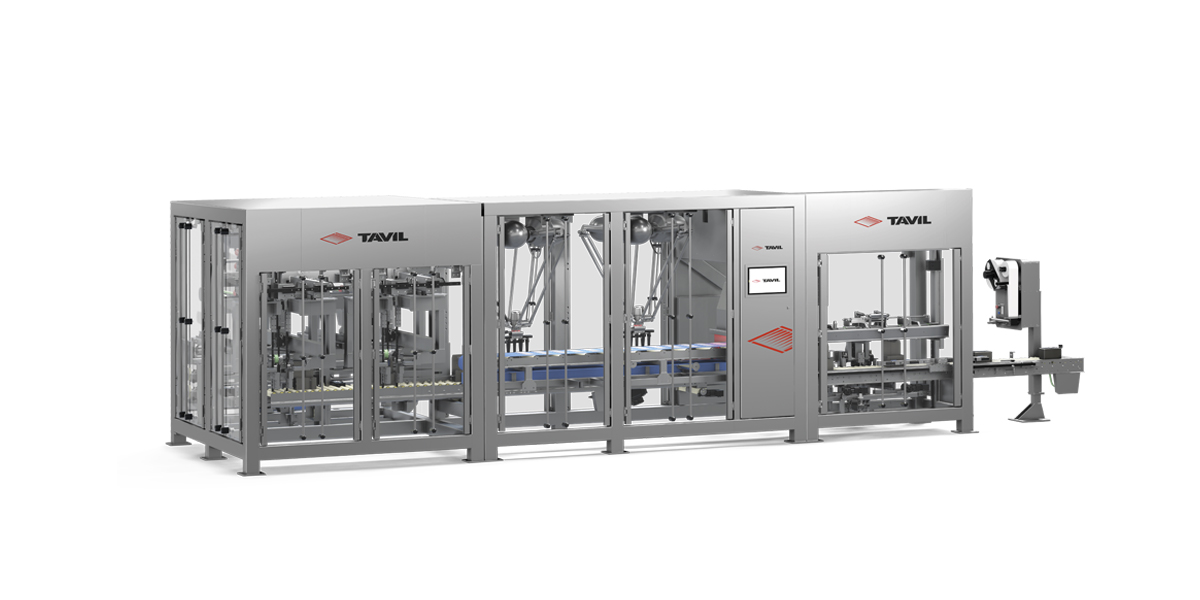
HFFS machines allow the packaging of a wide variety of products, including solids, granules, powders, liquids, and pastes, by integrating one or more dosing systems suited to each product type.
The machines support the installation of multiple dosing units, which can operate simultaneously or sequentially depending on the application and product type.
The packaging process is structured in independent and specific stations, which allow for the controlled execution of the following operations:
- Container forming - Product dosing - Container sealing. The modular architecture of HFFS machines allows for configuring the number and type of stations required for each application.
The main technical advantages of this configuration are:
- Compatibility with various dosing systems (volumetric, gravimetric, screw conveyor, pumps, multihead, among others)
- Possibility of incorporating multiple dosing stations for mixing different products in the same container - Multi-stage dosing to increase production capacity or improve accuracy - High process repeatability thanks to the functional separation of the stations - Adaptability to product changes without modifying the main machine structure - Easy integration with peripheral systems and automated lines
HFFS machines operate using roll material. The package is formed directly on the machine during the packaging process.
Using roll material allows all critical package forming and sealing operations to be performed internally. In particular, the top seal is executed after product dosing, and this is one of the key operations for ensuring the package's airtightness.
In applications using pre-formed pouches, this final sealing operation must also be performed on the packaging machine, so the responsibility for the package's airtightness also rests with the HFFS. Incorporating automatic format change systems into HFFS machines that operate from roll material allows for levels of flexibility equivalent to or greater than those of systems based on pre-formed pouches, without relying on pre-made package formats.
We have machines in stock that only need to be customized according to the client's project requirements for very short lead times. The delivery time for an HFFS machine depends on the degree of customization required for each project.
HFFS machines are based on a modular architecture and standard platforms. This allows us to have machines in stock that can be configured later by adding or adapting specific modules according to the application's technical requirements.
In these cases, the delivery time is reduced and is mainly limited to the configuration, integration of the dosing systems, functional testing, and validation phases.
At most manufacturers in the sector, HFFS machines are manufactured entirely to order and do not start from modular platforms in stock. This approach requires starting the process from the design and manufacturing phases, which increases the delivery time.
The combination of modular architecture and the availability of machines in stock allows for faster implementation, while maintaining the required functional flexibility and technical performance.
HFFS machines allow the production of a wide variety of pouch types, depending on the machine configuration and integrated modules.
The main types of pouches that can be produced include:
- Three-seal pouches
- Four-seal pouches
- Gusseted pouches
- Doypack pouches
- Doypack pouches with a top cap
- Doypack pouches with a corner cap
- Zipper pouches
- Specially shaped pouches
- Pouches with handles
The modular architecture of HFFS machines allows for the incorporation of the necessary systems for each type of pouch, as well as combining different features in the same package when the application requires it.
An HFFS machine can be operated by a single operator.
The operator is primarily responsible for feeding and replacing the film reels, as well as basic process monitoring.
The machine's automatic operation allows the container forming, dosing, and sealing operations to be performed without continuous manual intervention.
Yes. HFFS machines can work with recyclable films as long as they incorporate systems suited to the characteristics of this type of material.
In Tavil HFFS machines, these systems are integrated as a standard configuration, allowing work with recyclable films without the need for additional structural modifications.
The standard systems include:
- Double film transport systems with active tension control
- Ultrasonic sealing systems, avoiding the application of direct heat to the film
- Continuous film unwinding systems, instead of intermittent unwinding
- Continuous motion machine architecture, avoiding repetitive accelerations and decelerations of the film.
In other industry approaches, these systems are usually only incorporated as options or specific configurations. The availability of these systems as standard facilitates the stable processing of recyclable films and process validation from the start.
A multi-format packaging line handles jars of baby food of varying sizes during the same shift by automatically adjusting the format based on stored production recipes. The system modifies gripping positions, grouping patterns, and box dimensions without requiring mechanical retooling, thus maintaining productivity and alignment accuracy.
Servomotor-controlled movements regulate positioning tolerances for small and large diameter jars, ensuring stable grouping and uniform box loading across multiple product lines.
A motion-controlled packaging system protects fragile glass jars of baby food by:
- Regulating placement speed and acceleration
- Controlling gripping pressure
- Precisely orienting the product
- Minimizing impact during placement and insertion
- This reduces the risk of breakage while maintaining cycle time stability.
Motion control algorithms adjust deceleration curves and contact force according to the jar's weight and format configuration.
Frequent SKU changes in the production of baby food purees and packaging are managed through an automated, recipe-based reconfiguration that updates:
- Product grouping logic
- Box dimensions
- Layer stacking patterns
- Pallet arrangement parameters
- The transition occurs without manual adjustments, reducing downtime in highly variable production environments.
Digital format management ensures repeatability and traceability in short production runs and seasonal product launches.
A multi-format packaging system accommodates both cardboard boxes and flexible pouches for baby food, automatically adapting the gripping systems, orientation control, and box configuration.
This enables consistent secondary packaging of rigid and semi-flexible containers within the same end-of-line architecture.
Controlled motion handling is particularly relevant for lightweight pouches, where positioning accuracy and product stability influence the uniformity of the pallet load.
A programmable palletizing system adapts to boxes of light and mixed baby food by:
- Automatic adjustment of layer arrangement
- Optimization of weight distribution
- Modification of stacking sequences
- Control of compression levels
This ensures pallet stability for boxes of varying dimensions and product densities.
Dynamic pattern generation allows for the production of mixed products while maintaining transport resistance and meeting warehouse handling requirements.
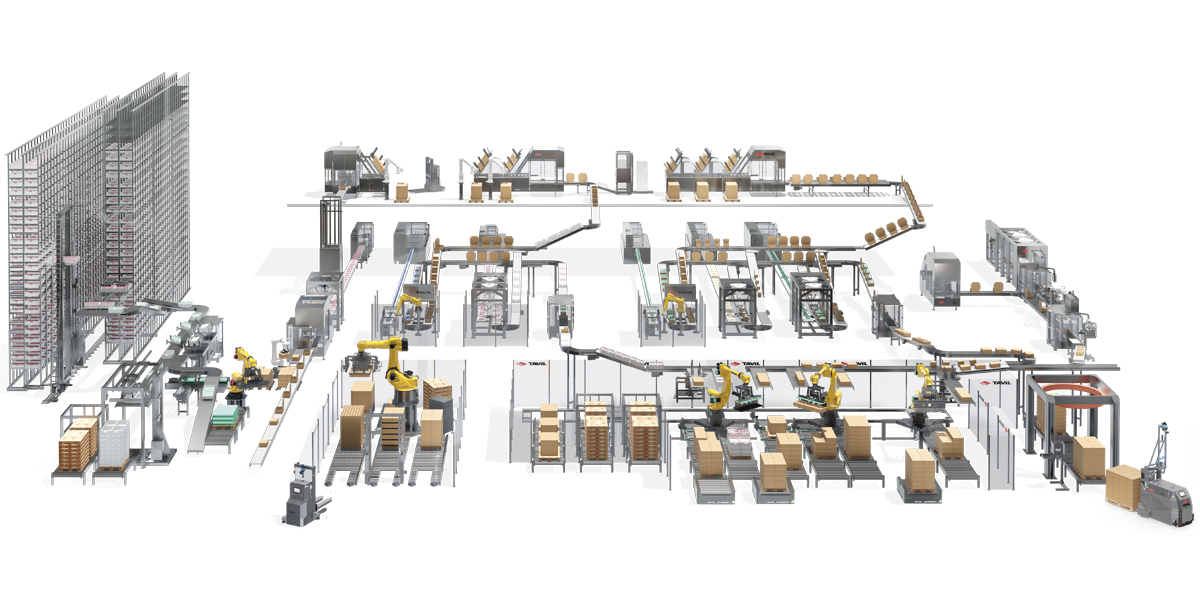
Multi-format end-of-line automation in infant food plants offers: reduced changeover times between SKUs, increased equipment availability, controlled handling of fragile packaging, adaptation to frequent product innovation, and integrated case and palletizing control.
These features allow for consistent production performance in regulated infant nutrition environments.
A multi-format packaging line handles jars of baby food of varying sizes during the same shift by automatically adjusting the format based on stored production recipes.
The system modifies gripping positions, grouping patterns, and box dimensions without requiring mechanical retooling, thus maintaining productivity and alignment accuracy.
Servomotor-controlled movements regulate positioning tolerances for small and large diameter jars, ensuring stable grouping and uniform box loading across multiple product lines.
A motion-controlled packaging system protects fragile glass jars of baby food by:
- Regulating placement speed and acceleration
- Controlling gripping pressure
- Precisely orienting the product
- Minimizing impact during placement and insertion
- This reduces the risk of breakage while maintaining cycle time stability.
Motion control algorithms adjust deceleration curves and contact force according to the jar's weight and format configuration.
Frequent SKU changes in the production of baby food purees and packaging are managed through an automatic, recipe-based reconfiguration that updates:
The transition occurs without manual adjustments, reducing downtime in highly variable production environments.
Digital format management ensures repeatability and traceability in short production runs and seasonal product launches.
A multi-format packaging system accommodates both cardboard boxes and flexible pouches for baby food, automatically adapting the gripping systems, orientation control, and box configuration.
This enables consistent secondary packaging of rigid and semi-flexible containers within the same end-of-line architecture.
Controlled motion handling is particularly important for lightweight pouches, where positioning accuracy and product stability influence the uniformity of the pallet load.
A programmable palletizing system adapts to boxes of light and mixed baby food by:
This ensures pallet stability for boxes of varying dimensions and product densities.
Dynamic pattern generation allows for the production of mixed products while maintaining transport resistance and meeting warehouse handling requirements.
Multi-format end-of-line automation in infant food plants offers:
- Reduced changeover time between product lines
- Increased equipment availability
- Controlled handling of fragile packaging
- Adaptability to frequent product innovation
- Integrated packaging and palletizing control
These features guarantee consistent production performance in regulated infant nutrition environments.
These systems are particularly relevant in facilities with short product lifecycles, strict hygiene standards, and a growing diversification of product lines.
A multi-format packaging line is required in nutritional production when:
- Multiple product formats (cans, bottles, sachets, boxes) are processed on the same line.
- Frequent SKU changes occur.
- High-variety production must maintain efficiency.
- Packaging and palletizing parameters must be automatically adjusted.
- These systems maintain operational continuity without requiring mechanical retooling.
Applications typically include powdered supplements, liquid nutrition, and portioned formats. Automatic adjustments can encompass box dimensions, product grouping logic, and pallet arrangement configurations without requiring mechanical retooling.
Frequent SKU changes are managed through recipe-based automation that controls servomotor movements and configuration parameters.
Box layouts, grouping patterns, and pallet stacking sequences are automatically adjusted, reducing downtime and ensuring repeatable transitions between product nutritional references.
Digital format management enables traceable and consistent reconfiguration, which is especially relevant in facilities with high product turnover and batch production.
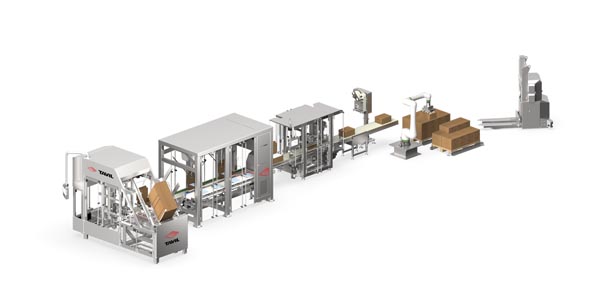
A controlled, multi-format packaging system handles cans, bottles, and sachets, automatically adjusting gripping systems, product orientation, and box configuration. This ensures consistent secondary packaging performance across both rigid and flexible nutritional formats.
Motion control algorithms regulate placement accuracy and handling force, maintaining package integrity and cycle time stability.
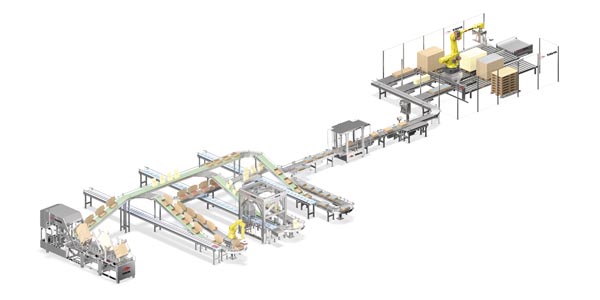
Box packaging is integrated with palletizing through:
- Synchronized control architecture
- Alignment between box output and layer formation
- Automatic pallet configuration adjustment
- Unified format change logic
- Balanced coordination of the production flow at the end of the line.
This ensures stable performance during SKU transitions.
Integration typically includes centralized PLC control, automatic pallet pattern calculation, and data exchange with upstream filling or inspection systems.
A programmable palletizing system with automatic layer configuration adapts to different box sizes by modifying stacking patterns, orientation, and load distribution parameters.
The system guarantees stable pallet formation without the need for manual mechanical adjustments.
Dynamic pallet pattern generation allows for handling mixed products while maintaining transport stability and warehouse efficiency.
Multi-format automation in nutrition plants offers:
- Reduced changeover times
- Increased line availability
- Adaptability to high SKU variability
- Uniform handling of different packaging types
- Integrated packaging and palletizing flow
- Greater batch-to-batch repeatability
- Reduced manual intervention
These features promote controlled and efficient production in regulated nutrition manufacturing environments.
These systems are especially relevant in plants that produce clinical nutrition, dietary supplements, and specialized formulations with frequent product turnover.



 }
}