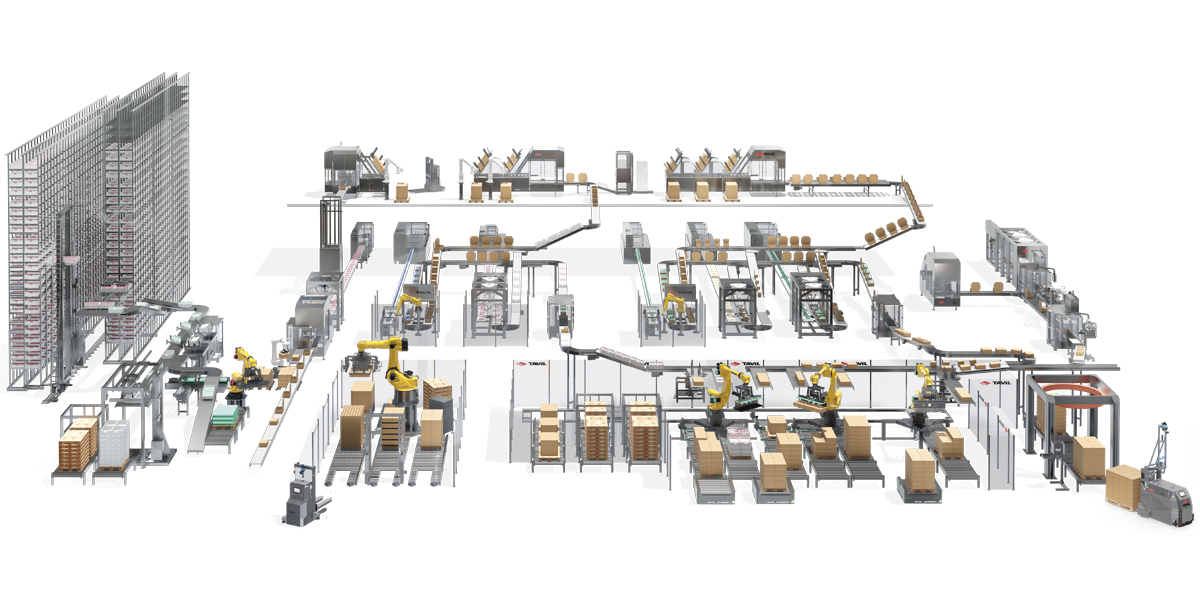
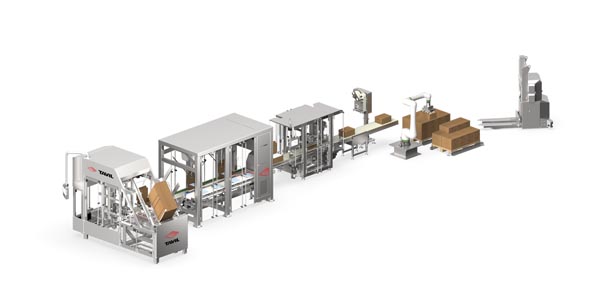
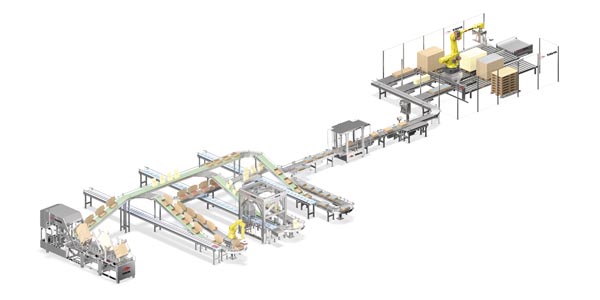
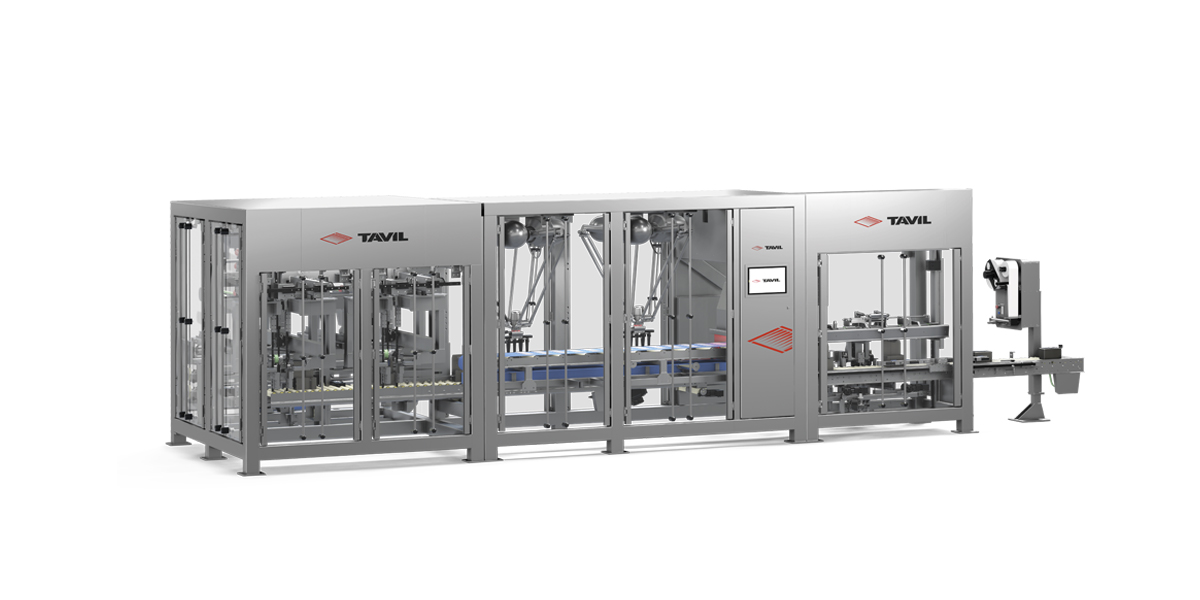
Automated case packing and palletizing solutions for the coatings industry are applied in multiple sectors where liquid, paste, or powder products are handled in various packaging formats.
These systems automate the end of the line, guaranteeing load stability, stacking precision, and adaptability to different container types.
They are commonly used in:
- Decorative and industrial paints
- Coatings and varnishes
- Construction sector (plaster, mortars, adhesives)
- Waterproofing and resins
- Industrial inks
- Sealants and technical chemicals
Automated end-of-line systems can be configured to handle different types of industrial packaging, adapting the gripping system and the packing or palletizing pattern according to the product's weight, geometry, and stability.
This type of solution allows for the automation of processes with multiple formats in a single installation.
- Cardboard boxes
- Industrial paper or plastic sacks
- Single or multi-layer flexible bags
- Industrial pallets or buckets (plastic or metal)
- Rigid or semi-rigid containers
- Shrink-wrapped or tray-packed bundles
A multi-format system allows working with different product and packaging sizes in the same installation, automatically adjusting parameters without manual intervention.
This improves line availability and reduces downtime associated with mechanical changeovers.
Its main benefits include:
- Reduced changeover times
- Greater production flexibility
- Less operational dependence
- Optimized OEE
- Adaptability to short batches
In environments with multiple product lines and sales channels, a multi-format solution allows for automatic switching between cans, boxes, or pails without prolonged manual intervention. This reduces downtime and improves operational flexibility in plants with high product variability.
This is especially relevant when there are:
- Frequent format changes
- Production for retail and industrial use
- Different capacities (1L, 5L, 15L, etc.)
- A need to alternate between individual and grouped packaging
- Different logistical requirements
A multi-format line can be configured to handle both individual cans and cardboard boxes, performing automatic format changes without manual mechanical adjustments. This allows for alternating production for different channels or SKUs within the same facility, maintaining efficiency and operational continuity.
The system can handle:
- Individual metal cans
- Shrink-wrapped bundles
- Cardboard boxes
- Trays with film
- Different heights and diameters
- Variable palletizing patterns
Packing and palletizing systems can be designed to operate in environments with a risk of explosive atmospheres (ATEX) or with high levels of dust, provided that electrical components, protective devices, and safety configurations are adapted in accordance with applicable regulations.
The solution must guarantee operational continuity and industrial safety under demanding conditions. Adaptation may include:
- ATEX-certified components
- Protected motors and electrical panels
- Ventilation or overpressure systems
- Dust accumulation protection
- Sensors and wiring specific to the classified area
- Structural design compliant with safety regulations
Oval paint cans can be automatically palletized provided the system accommodates their specific geometry. Due to their non-cylindrical shape, they require adapted pallet patterns and precise positioning control to ensure load stability and correct alignment in each layer.
The solution can be configured to work with:
- Different oval can dimensions
- Controlled orientation in pre-gripping grouping
- Individual or grouped handling
At Quemical, a multi-format packaging line is required when:
- Different types of containers (drums, buckets, cans, bottles) are processed on the same line.
- Variable container volumes must be processed.
- Frequent format changes are required.
- Downtime must be minimized in high-volume production.
- Packaging and palletizing parameters require automatic adjustment.
This allows for continuous flow in industrial environments without the need for mechanical retrofitting.
Common container formats include drums, buckets, cans, and bottles with varying capacities. The system adapts box dimensions, product grouping, and pallet arrangement without manual mechanical intervention.
Frequent container size changes are automated using servo-controlled systems and recipe-based configurations. Gripper positions, packing sequences, and pallet stacking patterns are automatically adjusted, eliminating manual intervention and reducing changeover times.
Recipe-based automation ensures repeatable transitions between product types, maintaining load stability and precise alignment for cylindrical or rectangular containers.
A multi-format packaging system with controlled motion accommodates drums, buckets, and cans, automatically adapting the gripping mechanisms, product orientation, and box configuration. This enables consistent secondary packaging of containers with varying geometries and weights.
Motion control parameters regulate the placement speed and gripping force, which is particularly relevant for heavy and high-density chemicals.
Packaging and palletizing are integrated through:
- Synchronized control architecture
- Coordination between box packing and layering
- Automatic pallet pattern generation
- Conveyor belt alignment and load stabilization
- Unified format change logic.
This creates a continuous and balanced workflow across multiple container formats.
Integration typically includes centralized PLC control, conveyor belt synchronization, and programmable pallet pattern generation tailored to industrial logistics and warehousing requirements.
A programmable palletizing system, designed for heavy-duty applications, adapts to the heavy-duty Quemical containers by automatically configuring stacking sequences, layer distribution, and load reinforcement parameters. This ensures stable pallet formation without the need for mechanical adjustments.
The dynamic layer calculation accommodates containers of varying weights and dimensions, meeting transport and warehouse handling standards.
Multi-format automation in Quemical's production offers:
- Reduced format changeover times
- Increased line availability
- Adaptability to multiple container types and sizes
- Stable pallet formation for heavy loads
- Optimized load distribution for transport
- Integrated packaging and palletizing control
- Greater performance consistency
These features promote consistent and highly efficient industrial coating manufacturing.
These systems are especially relevant for plants with a wide variety of products, frequent batch changes, or private label production that require precise handling and performance stability.



 }
}