Technologies that simplify automated guided vehicle (AGV) traffic include:
- Fleet management software with centralized control
- Dynamic routing algorithms
- Real-time location systems (RTLS)
- AI-based traffic prioritization
- Automatic collision avoidance systems
These solutions allow multiple vehicles to move efficiently through shared spaces, adapting to changing production demands.
Integration with MES, ERP, or WMS enables predictive route planning. AI-based traffic optimization adapts to changes in line production and varying pallet sizes, maintaining throughput and minimizing downtime.
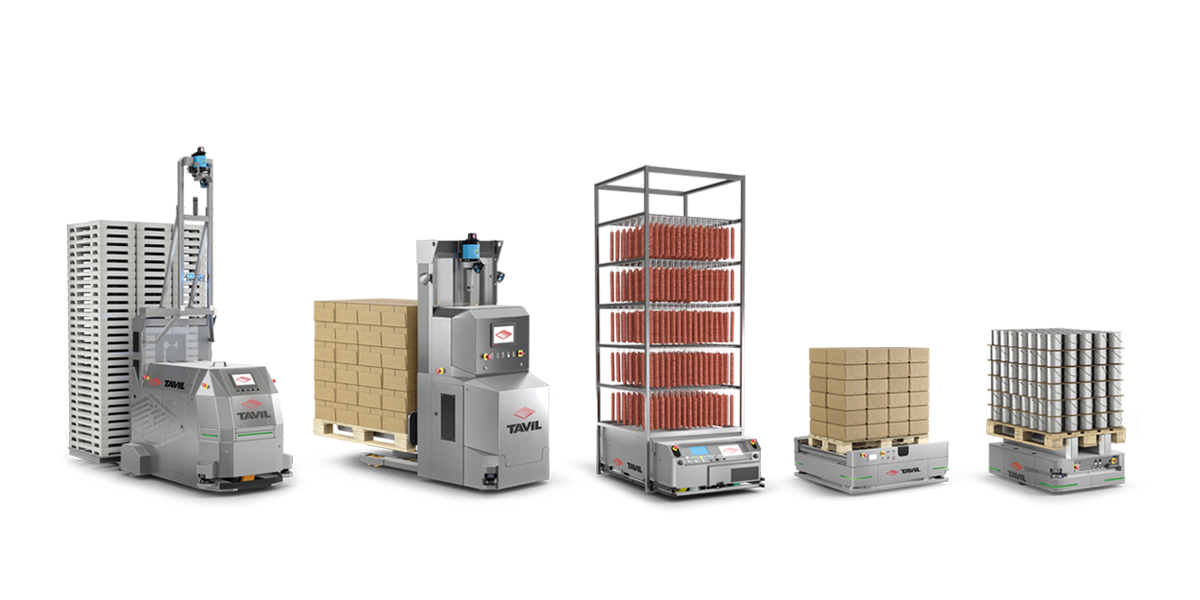
AGVs can handle multi-format pallets using adjustable forks, automated grippers, or tray adapters. Integrated load sensors detect variations in weight and size, allowing for dynamic adjustment of gripping force, lifting height, and transport speed.
For irregular or fragile containers, motion control algorithms manage acceleration and deceleration profiles, ensuring product stability in batches with different SKUs and reducing the risk of pallet deformation.
Bottlenecks are reduced through:
- Intelligent fleet orchestration
- Route prioritization based on line status
- Zone-based traffic control
- Digital mapping and real-time rerouting
- Automatic speed adjustment in congested areas
These strategies prevent traffic buildup near palletizers, wrappers, or warehouse entrances.
Digital twin simulations allow for the validation of AGV traffic flows before implementation, improving efficiency in high-volume, multi-line operations.
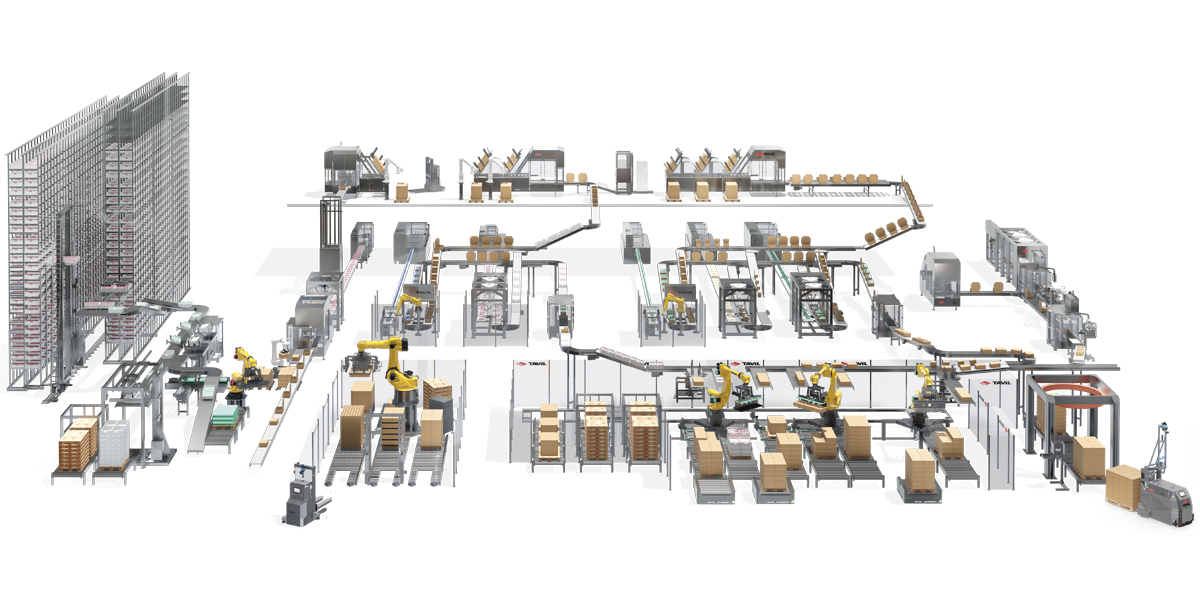
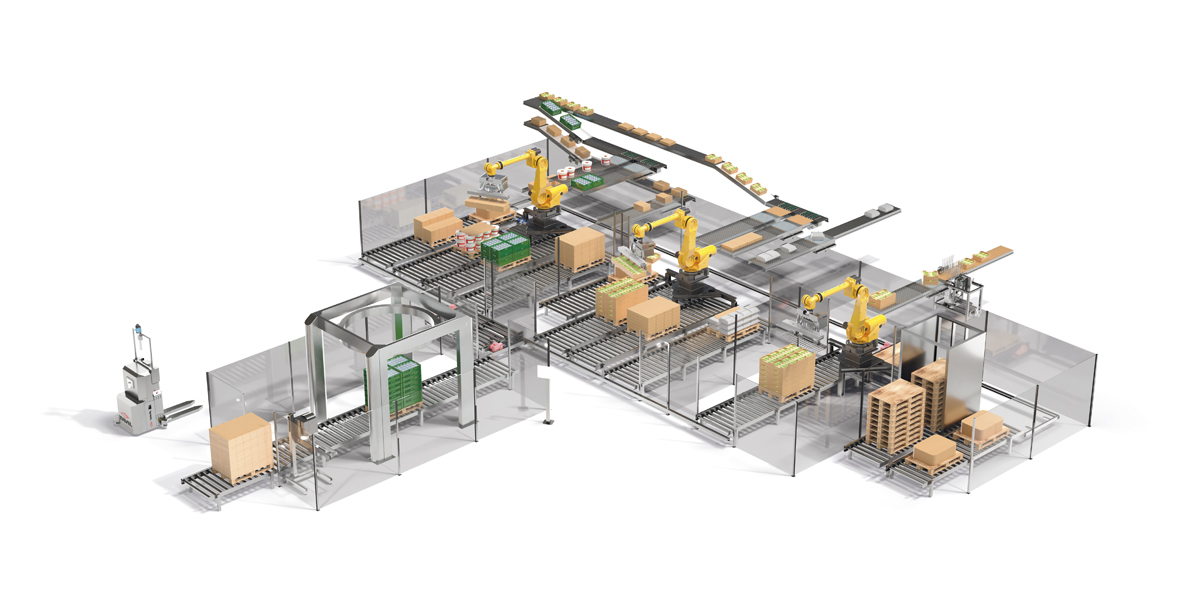
The AGV system integrates with the packaging lines via synchronized control software. Finished pallets or containers are automatically collected and transported to storage or shipping areas, and empty pallets are returned to the lines—all without manual intervention.
The integration includes real-time communication with PLCs, MES, or ERP systems, enabling automatic adjustment of AGV routes based on line stops, batch priorities, and the specific requirements of each SKU.
Emerging technologies that improve the safety and reliability of AGVs include:
- LiDAR obstacle detection
- AI-powered vision systems
- Real-time 3D mapping
- Predictive maintenance analytics
- Redundant safety sensors
These technologies enable safe navigation in dynamic environments shared with forklifts and operators.
Continuous self-diagnostics and adaptive braking profiles improve uptime while meeting industrial safety standards.
AGVs improve efficiency by:
- Automating pallet transport between production stages
- Adapting to varying pallet dimensions and weights
- Eliminating reliance on manual forklifts
- Optimizing warehouse space utilization
- Maintaining a continuous flow of materials
- Reducing handling-related damage
This facilitates flexible logistics in complex industrial environments with multiple SKUs.
AI-powered route optimization and load-sensitive motion control allow AGVs to respond dynamically to production fluctuations.
A counterbalanced AGV is preferred when:
- Loads without support legs under the pallet must be handled.
- Closed pallets or non-standard bases are used.
- Direct picking from the ground is required.
- Heavy industrial loads require greater stability.
- Operations are replacing traditional counterbalanced forklifts.
This configuration offers greater flexibility in confined industrial spaces.
Counterbalanced AGVs replicate the geometry of conventional forklifts but incorporate autonomous navigation, making them ideal for modernizing existing logistics environments.
AGVs improve pallet transfer between palletizers and stretch wrappers by:
- Eliminating fixed conveyor lines
- Eliminating floor cables and mechanical transfer systems
- Eliminating physical routing restrictions
- Enabling dynamic rerouting of materials around obstacles
- Reducing infrastructure complexity
This increases layout flexibility and simplifies plant expansion.
Unlike traditional systems with integrated cables or mechanical chain conveyors, AGVs use natural navigation or laser guidance, enabling scalable and unobstructed material flow without structural modifications.



 }
}